


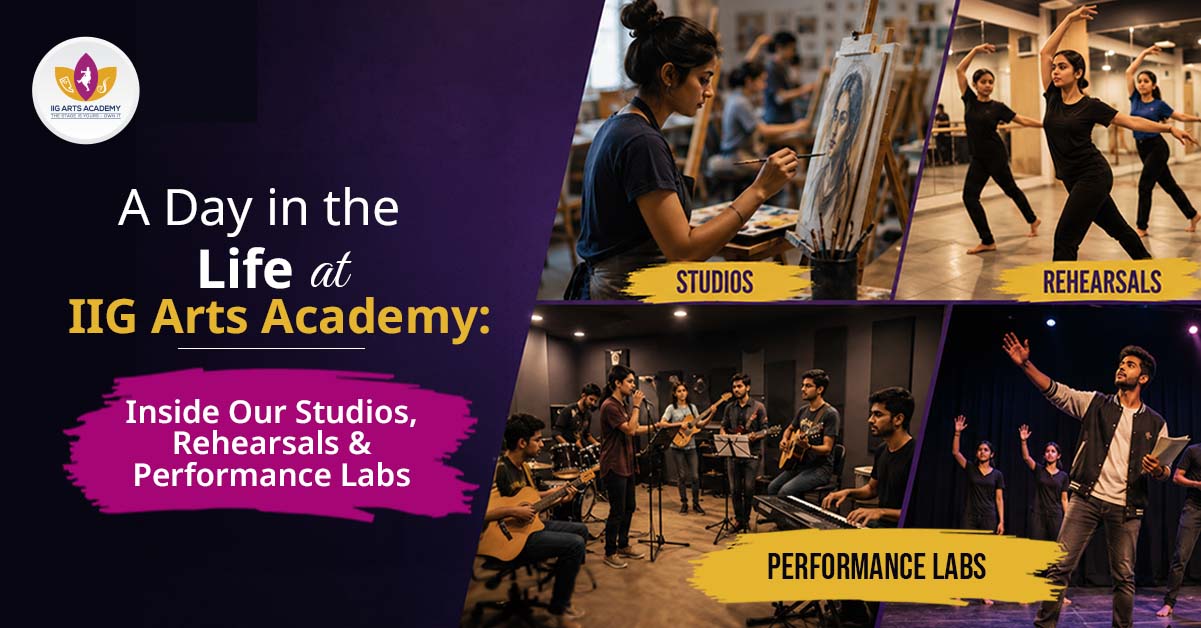
By the time one studio has found its rhythm, another is already starting again. A piano phrase travels down the corridor, dancers count through a sequence, and somewhere inside the theatre room, a scene has just been stopped so the students can try it once more.
That is what a normal day at IIG Arts Academy, Bhubaneswar, feels like. It is active, creative and full of small moments of learning.
For students and parents exploring theatre and drama training in Bhubaneswar, this everyday learning is often more important than the final performance. The stage may show the result, but the real progress comes from regular practice, guidance and the confidence students build over time.
The Day Starts With Practice
Most creative learning begins with the basics. Theatre students work on voice, movement and acting, dancers focus on rhythm and technique, while music students spend time with vocals or instruments.
At IIG Arts Academy, the focus is on hands-on learning through studio practice, rehearsals and performance-based sessions. Students are not only introduced to concepts. They also get regular opportunities to apply what they are learning.
That repeated process of practising, correcting and trying again gradually helps creative skills become more natural.
Inside the Theatre Room
Theatre training is much more than memorising dialogue. Students work on acting, stagecraft, direction, playwriting, voice and speech, while also learning through workshops, improvisation and stage productions.
This is what makes theatre and drama training practical. A scene can be rehearsed, discussed and performed again until students begin to understand character, movement and expression more naturally.
Theatre students may work on:
- Acting and improvisation
- Voice and speech
- Movement
- Character development
- Stagecraft
- Scriptwriting and direction
- Live performance
These areas help students understand both the creative and practical sides of theatre. A 2026 course from Ambedkar University Delhi also highlights theatre, improvisation and practical creative learning as important parts of arts education.
Dance Brings a Different Energy
The dance spaces have a different pace. Students work with movement, rhythm, technique and expression, depending on the style they are learning.
The academy currently lists Bharatanatyam, Odissi, Contemporary, Hip-Hop and Folk Dance among its main dance programmes, along with other modern styles across its wider dance offerings.
Families searching for a Classical dance academy in Bhubaneswar may also be comparing different classical dance forms available in the city. At IIG Arts Academy, the currently listed classical options include Odissi and Bharatanatyam, so students can choose based on the form they genuinely want to learn.
Indian classical and folk traditions also continue to receive institutional support. As per a press release by PIB on the promotion of Indian Classical Dances amongst students, highlights initiatives involving workshops, lectures and performances that encourage greater exposure to traditional art forms.
Music Moves From Practice to Production
Music is another major part of the day. The academy currently offers Indian classical music, Hindustani and Odissi vocals, along with instruments such as guitar, drums, tabla, dholak, keyboard, harmonium, violin and piano.
Music learning can also move into production. Students interested in composition and recording can begin to understand how music is arranged, recorded, mixed and developed beyond the rehearsal room.
For students, this creates a natural connection between practising voice or an instrument and understanding how music can eventually be developed into a finished piece.
Regular rehearsal matters here too. Musical confidence develops through repetition, listening, correction and the experience of performing individually or with others.
Art and Photography Bring in a Different Kind of Focus
Not every part of the academy is built around performance. Students interested in visual art can explore drawing, painting, sketching, mixed media, set design and costume art.
Photography brings its own way of learning. Students begin to understand framing, lighting and visual storytelling, helping them see how everyday moments can be turned into meaningful images.
These areas may feel quieter than theatre or dance, but the process is similar. Students observe, practise, correct and slowly become more confident in how they express an idea.
Rehearsals Are Where Students Improve
Rehearsals are an important part of the academy’s learning approach. A student may need to repeat a scene, a step or a musical section several times before it begins to feel comfortable.
That repetition is useful because it gives students time to notice mistakes, take feedback and improve them. It also helps them understand that creative work does not need to be perfect on the first attempt.
For families comparing the best acting school in Bhubaneswar, this kind of regular practice is worth paying attention to. Strong theatre learning happens long before the final performance, not only during it.
Performance Spaces Make Learning More Real
The academy’s facilities are designed around practical creative work. The website lists dance studios and theatre halls, music practice spaces, acoustic rooms, digital media labs, visual arts studios and costume labs.
It also highlights black box theatres, music recording studios, dance rooms and dedicated creative spaces. These give students a chance to practise in environments that are closer to actual performance and production settings.
Students can gradually become more comfortable with:
- Performing in front of others
- Using a stage or rehearsal space
- Working with other students
- Taking feedback
- Repeating and improving their work
- Moving from practice to presentation
These experiences can make the transition from classroom learning to live performance feel more natural.
When Different Art Forms Come Together
One of the most interesting parts of the academy is that art forms do not always stay separate. Theatre, music, dance and design can often come together during creative projects and performances.
A theatre student may begin to understand how music changes the mood of a scene. A dancer may notice how costume, lighting and visual design affect a performance. A visual arts student may contribute to set design or stage presentation.
These connections give students a wider view of creativity. Instead of seeing theatre, music, dance and design as isolated subjects, they begin to understand how different artistic skills can support one another.
The Bottom Line
Not every day needs to end with a big performance. Sometimes progress is simply understanding a difficult technique, becoming more confident in rehearsal or being able to perform something more comfortably than before.
For students, that progress can feel personal. For parents, it can be reassuring to see that learning is happening step by step rather than only through final shows or competitions.
At IIG Arts Academy, the day-to-day experience is built around studio practice, rehearsals, performance-based learning, creative work and exposure across different art forms.
For students looking for theatre and drama training in Bhubaneswar, music, dance or visual arts, that means the learning happens through doing. The performance comes later. First comes the practice that makes it possible.
Frequently Asked Questions
Students can explore theatre, music, dance, visual and fine arts, drawing, photography, visual communication and music production.
Students work on acting, voice, movement, improvisation, character development, stagecraft and performance through practical sessions and rehearsals.
Rehearsals give students time to practise, understand mistakes, take feedback and become more comfortable before performing.
The academy includes rehearsal rooms, music and dance studios, creative labs, theatre spaces and other areas designed for practical learning and performance preparation.
Also Read : The 5 Biggest Mistakes Parents Make When Choosing an Art Academy